
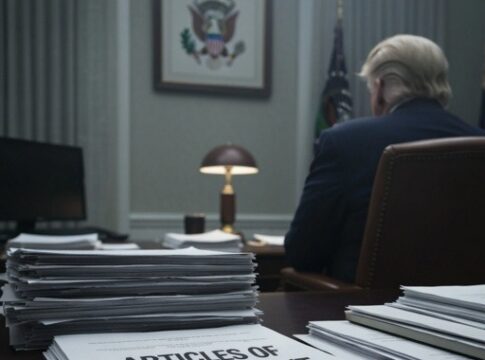
The Brennan case matters because it sits at the fault line between two very different things: a routine false-statements referral and a law-enforcement system that, by the available reporting, appears to have been repeatedly bent around politics. The central question is not whether Brennan is a controversial figure; it is whether the machinery around his investigation can still be trusted to separate evidence from retaliation.
Intro Header
- The formal predicate for the probe is a House Judiciary Committee referral alleging Brennan lied to Congress about the 2017 intelligence assessment on Russian interference.
- The strongest reporting on the prosecution side describes an investigation that advanced through subpoenas and witness interviews, but not without internal resistance.
- The strongest reporting on the defense side shows abrupt prosecutor turnover, subpoena withdrawals, and private doubts inside the Justice Department about the case’s legal footing.
- What emerges is less a clean case file than an institutional credibility test: the evidence claims are real, but so are the signs of political contamination.
The legal theory behind the Brennan probe
At its core, the investigation rests on a narrow but potent allegation: that Brennan gave false testimony to Congress about his role in the intelligence community’s 2017 assessment of Russian interference. The House Judiciary Committee’s referral says Brennan denied CIA reliance on the Steele dossier and mischaracterized the agency’s stance on including it in the assessment; that referral is the formal legal predicate that gave the case its prosecutorial opening. NBC also reported that Brennan’s legal team was told he was a target of a grand jury investigation concerning that assessment, confirming that the probe was not merely speculative but had entered active criminal-process territory.
That matters because false-statements cases rarely turn on broad political narratives. They turn on discrete questions of testimony, documentary contradiction, intent, and materiality. If prosecutors can show that a witness knowingly said something untrue to Congress, the case can be viable even when the surrounding dispute is politically radioactive. That is the government’s theory here. The difficulty is that a theory of prosecution is not the same thing as a robust case, and the reporting suggests this distinction became central almost immediately.
Why the internal resistance is the real story
The most consequential reporting does not come from the rhetoric of the referral itself; it comes from the inside of the Justice Department. AP reported that a national security prosecutor in Florida departed after expressing skepticism about the legal foundation for a possible criminal case, and that the department then withdrew subpoenas it had just issued, shifting instead to voluntary interviews. CBS likewise reported that the senior career prosecutor overseeing the Brennan matter was removed after raising concerns about the strength of the evidence, then replaced by Joseph DiGenova, a figure identified in the reporting as a staunch Trump ally.
That sequence is not incidental; it is diagnostic. When a politically sensitive investigation loses a career prosecutor over evidentiary concerns, and then shifts toward a loyalty-tested political appointee, the public can no longer separate legal judgment from institutional pressure with much confidence. CNN’s March reporting described exactly that atmosphere, saying top Justice Department officials were pressing prosecutors to bring charges while career lawyers in southern Florida viewed the case as relatively weak. In any ordinary criminal case, such friction would be noteworthy. In a case involving one of Donald Trump’s longstanding intelligence-world antagonists, it is dispositive of the question of whether the process itself has been politicized.
The evidentiary record is real, but it is not clean
It would be too easy to dismiss the prosecution side as wholly theatrical. There is a genuine documentary basis for the inquiry, and the FBI and DOJ did not invent it from thin air. NBC reported that FBI agents were interviewing current and former CIA officers specifically about Brennan’s testimony and the dossier’s role in the 2017 assessment. Just the News reported that federal prosecutors sought years-old Senate material in a bid to examine Brennan’s testimony trajectory over time. Those are classic pre-indictment steps, and they indicate that the government was trying to assemble a record rather than merely posture for television.
But the mere existence of evidence-gathering does not resolve the harder issue: whether the investigation’s steering mechanism was neutral. CBS reported that multiple sources feared some line prosecutors and FBI agents may harbor political motivations, and that the case was being staffed in a way that invited doubts about impartiality. AP’s account of a prosecutor departing over the lack of a viable charge cuts in the same direction. Put bluntly, the government may have enough to investigate; it does not follow that it has assembled a clean, legally durable basis to charge.
Brennan’s strongest argument is not innocence alone, but process
Brennan’s legal team has leaned into the process argument, characterizing the matter as a concocted, politically motivated, fact-free criminal investigation in correspondence to Chief Judge Aileen Cannon. That language is sharp, but the underlying claim is more substantial than the rhetoric. In a prosecution shaped by abrupt reversals, personnel changes, and visible partisan gravity, the defense does not need to prove the government’s motive to raise serious doubt about the fairness of the enterprise. It needs only to show that the case’s trajectory reflects political selection effects that would never survive in a less charged environment.
That is where the subpoena reversal becomes so important. AP reported that subpoenas were issued over the weekend and withdrawn by Monday evening, with investigators moving to voluntary interviews instead. In a stable, evidence-driven investigation, that kind of whiplash usually means one of two things: the case was underdeveloped, or the legal team could not agree on the best path forward. Either explanation is damaging when the target is a former intelligence chief accused of lying to Congress about one of the most politicized intelligence questions of the last decade.
Former CIA Director John Brennan filed a lawsuit Wednesday seeking to preserve records tied to investigations involving him. The filing asks the DOJ, White House, ODNI, CIA, and Acting AG Todd Blanche to preserve communications and materials https://t.co/wYZNhvprZM
— MAGA G (@MAGAGlovesX) July 1, 2026
Why this case echoes a larger pattern
Brennan’s suit does not exist in a vacuum. The broader context, as reflected in the research package, is a presidency defined by aggressive retribution against former officials and intelligence figures who challenged Trump or participated in investigations that angered him. The White House itself has framed former intelligence officials like Brennan through a punitive lens, revoking clearances and invoking political misconduct. ABC’s coverage of other Trump-era prosecutions describes a wider “campaign of retribution” that critics say has swept up former officials such as James Comey and John Bolton.
That pattern matters because legal institutions do not operate in abstraction. When the Justice Department is perceived as a partisan instrument, even plausible cases become suspect; when it is staffed with loyalists and career skeptics are sidelined, those suspicions harden into a structural critique. The Brennan matter therefore functions as both a specific criminal inquiry and a case study in degraded institutional legitimacy. If the government eventually brings charges, the question will not only be whether Brennan lied. It will be whether a politically saturated DOJ can still prove that it is enforcing the law rather than settling scores.
What to watch next
The decisive facts are still the ones that remain least visible. The public still lacks a full view of the internal DOJ communications, the precise reasons for the prosecutor’s removal, and the documentary chain that prosecutors believe contradicts Brennan’s congressional testimony. Those materials would clarify whether the case is merely politically tainted or substantively weak as well. Until then, the best reading is restrained but firm: the investigation has a legal basis, yet the way it has been handled strongly suggests a system in which political motivation and prosecutorial discretion have become dangerously difficult to distinguish.
Sources:
cbsnews.com, judiciary.house.gov, nytimes.com, facebook.com, brennancenter.org, youtube.com, cnn.com, reddit.com, justsecurity.org, whitehouse.gov