
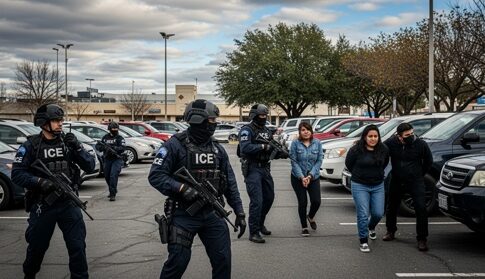
A federal judge has blocked Virginia from enforcing its new ban on masks for federal immigration officers, putting the state’s most aggressive transparency measure on hold before it could take effect and sharpening a familiar constitutional fight over who controls federal law enforcement on the ground.
Key Points
- The Justice Department sued Virginia to stop the mask ban and related identification rules from taking effect.
- The case turns on the Supremacy Clause and intergovernmental immunity, not on a disagreement over whether masking is politically unpopular.
- Virginia argues the rules promote accountability and public trust; the federal government says the state is trying to regulate federal officers directly.
- A similar California law was already blocked in federal court, giving the government a ready precedent for its challenge.
The constitutional problem is control, not symbolism
The legal issue here is straightforward in structure, even if the politics are noisy: a state can regulate behavior within its borders, but it cannot commandeer the operating methods of federal officers carrying out federal duties. That is why the Department of Justice framed Virginia’s law as an unconstitutional attempt to dictate how federal law enforcement agents perform their jobs, including whether they may wear face coverings and how they must identify themselves.
The complaint relies on the Supremacy Clause and the related doctrine of intergovernmental immunity, which generally bars states from directly regulating the federal government or singling it out for special burdens. In the government’s telling, Virginia’s statute does both at once: it reaches into federal operations, and it does so only for federal officers, not for state officers in the same way.
The practical effect matters because immigration enforcement is not performed in a vacuum. ICE operations often involve arrests, surveillance, and neighborhood-level contact, which is exactly the setting in which officers say masking can reduce doxing, harassment, and retaliation. The Justice Department argued that Virginia’s law would expose officers to those risks and chill operations by forcing a choice between compliance with state penalties and compliance with federal operational judgment.
What Virginia enacted
Virginia’s new law does two related things. First, it bars law enforcement officers from wearing facial coverings that conceal their faces while performing official duties, subject to limited exceptions. Second, it requires identification in specified circumstances, extending the transparency idea beyond masks alone and toward visible accountability.
That structure resembles recent laws in other states that have tried to respond to public anger over masked immigration raids by treating facial concealment as an accountability problem. California did this first, and New York and Washington have also moved in similar directions, which is why the legal question is no longer novel: courts have already been asked whether a state may impose mask and identification rules on federal officers, and the answer has so far been largely no when the law directly constrains federal conduct.
Virginia’s defenders argue that the law reflects a legitimate police-power interest in transparency, public confidence, and safety. That argument is not frivolous. In ordinary local policing, visible identity is a cornerstone of accountability, and states have a real interest in preventing impersonation and in ensuring people know who is exercising authority over them. But the constitutional problem begins the moment the law stops being a general transparency rule and becomes a device for controlling federal operations as such.
The DOJ’s position is built for injunction relief
The Justice Department did not simply object in the abstract; it filed suit seeking an order to block the Virginia law before it took effect on July 1. That timing matters, because preliminary injunction litigation is about imminent harm and the likely success of the legal theory, not a final merits ruling after years of discovery.
The government’s complaint makes the same core move it used in California: it argues that the state has no authority to criminalize the conduct of federal officers while they are performing official duties, especially where the conduct in question—masking—is tied to federal safety decisions and agency policy. It also contends that Virginia’s law would functionally interfere with cooperative 287(g) arrangements, the agreements that allow local agencies to work with federal immigration authorities.
That last point is important but more interpretive than empirical in the material available. The DOJ says the law would effectively chill or block such cooperation, yet the complaint as summarized here does not supply concrete examples of terminated agreements or a record showing the statute already forced local agencies to walk away. That does not make the argument weak; it means the strongest version of the case is constitutional, not documentary.
Judge blocks Virginia ICE mask ban on eve of implementation @joedodson16 https://t.co/uIO5jeTDot
— Courthouse News (@CourthouseNews) July 1, 2026
Why the precedent matters
Virginia is not litigating in a clean-room setting. A federal judge in California already blocked enforcement of a similar mask ban against federal immigration officers, while leaving intact a separate identification requirement for visible badges or agency information. The key distinction there was that the mask rule singled out federal officers in a way the court found impermissible, whereas the identification requirement could survive a different analysis.
That distinction is the real center of gravity in these cases. Courts are more receptive to neutral identification rules than to direct prohibitions on how federal officers dress or protect themselves while carrying out federal work. Put differently, the more a state law looks like a general transparency requirement, the more defensible it is; the more it looks like a command to federal personnel, the more likely it is to fall.
This is why the debate has become so combustible. For critics of ICE, masks symbolize secrecy, fear, and unaccountable power. For federal officials, masks are an operational tool in a climate of rising hostility and targeted exposure. Each side is talking past the other at the level of values, but in court the question is narrower: who has legal authority to decide?
What this signals for future immigration fights
The Virginia ruling fits a broader pattern that has intensified since 2020: states are increasingly testing transparency laws against federal immigration enforcement, and the federal government is responding by invoking supremacy and immunity doctrines to block them. The disputes are recurring because both sides have durable incentives. States want to show residents they are not facilitating opaque immigration actions; the federal government wants to preserve operational discretion, especially where officer safety is invoked.
What this means going forward is simple. Expect more laws that try to regulate masks, badges, staging areas, or access to sensitive state property; expect the DOJ to challenge them quickly; and expect federal courts to draw a line between general public-safety rules and statutes that directly regulate federal conduct. The Virginia case is less an outlier than the latest turn in a well-defined constitutional boundary dispute, one that will keep returning as long as immigration enforcement remains both politically explosive and operationally secretive.
Sources:
foxnews.com, facebook.com, washingtonpost.com, justice.gov, reddit.com, nccriminallaw.sog.unc.edu, nysenate.gov