
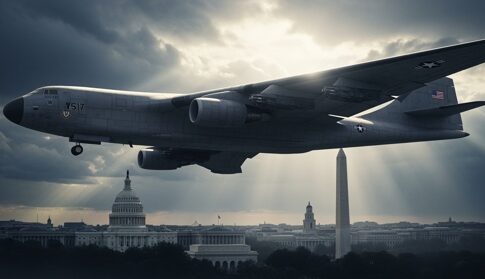
When the U.S. Army Golden Knights descend over the Washington Monument at sunset, trailing smoke against a June sky, what you are watching is not a stunt — it is a living demonstration of the institutional precision and public spectacle that the American military has refined over more than two centuries.
At a Glance
- The America 250 celebrations (June 11–19, 2026) produced an unprecedented concentration of military aerial spectacle over Washington, D.C., anchored by the Army’s 250th birthday on Flag Day, June 14.
- The U.S. Army Parachute Team — the Golden Knights — performed multiple jumps over the National Mall and Washington Monument, including a dramatic sunset jump and a Flag Day jump that carried the celebration’s symbolic weight.
- Twelve Air Force Thunderbirds and the Navy’s Blue Angels conducted a rare joint flyover, one of the most technically demanding formation displays either team performs.
- The aerial program culminated at UFC Freedom 250 on the White House South Lawn on June 19, where the Thunderbirds and Blue Angels again flew in formation as the National Anthem played before a seven-fight card.
- Separate and unrelated: a fatal skydiving accident in Missouri on June 14 involving a civilian aircraft had no connection to the military celebrations, though media proximity in timing created public confusion.
The Scale of What Actually Happened Over Washington
The America 250 aerial program was not a single event but a rolling sequence of military demonstrations spread across nine days, layered in complexity and coordinated across multiple service branches. Between June 11 and June 14, the National Capital Region became, in effect, a continuous airshow — one with the White House at its center and the National Mall as its stage. What made the program distinctive was not just the density of activity but the deliberate sequencing: practice flyovers visible to the public, then escalating formal performances tied to specific ceremonial dates, culminating in the UFC Freedom 250 event on June 19.
The Thunderbirds — the Air Force’s premier demonstration team, flying F-16 Fighting Falcons — led a twelve-aircraft formation over the White House during the lead-up period, a display of coordinated precision that few civilian airshows can replicate. Then, on the event itself, something rarer still: the Thunderbirds and the Navy’s Blue Angels flew together. These two teams operate under different service cultures, different aircraft (the Blue Angels fly the F/A-18 Super Hornet), and different formation traditions. A joint flyover requires weeks of coordination and represents a genuine logistical achievement, not merely a visual one. The Associated Press documented the display; President Trump and UFC president Dana White watched from the South Lawn as the aircraft swept overhead.
The Golden Knights: What They Are and What They Did
The U.S. Army Parachute Team has operated since 1959, when the Army established it as both a competitive parachuting unit and a public affairs instrument — a way to demonstrate military capability and recruit talent simultaneously. The Golden Knights are not hobbyist skydivers in uniform; they are active-duty soldiers, many with thousands of jumps, who compete internationally and perform at events ranging from county fairs to presidential inaugurations. The distinction matters because casual coverage of the America 250 events sometimes blurred the line between “skydivers over the White House” and the specific, highly choreographed military exhibition that actually occurred.
During the Freedom 250 week, the Golden Knights performed at least two distinct jumps over the National Mall corridor. A sunset jump over the Washington Monument — documented by the Defense Visual Information Distribution Service — captured the team descending in formation as the monument’s reflection shimmered below. On June 14, Flag Day and the Army’s 250th birthday, the team jumped again, with members gliding past the Washington Monument and landing in the Mall area. Point-of-view footage released by the team shows the jump from inside the aircraft — the hatch opening, the Mall spreading out below, the monument growing as altitude drops — the kind of primary-source material that collapses any ambiguity about what happened and who performed it.
Nitro Circus, the South Lawn, and the Danger of Conflation
One source of public confusion deserves direct clarification. On June 13 — the day before the Army’s birthday jump — Nitro Circus performed a freestyle motocross jump on the White House South Lawn, a separate event involving Travis Pastrana and the extreme sports collective known for motorcycle and stunt spectacles. This was not a parachuting event; it was a motocross exhibition. The overlap in dates, location, and the general atmosphere of the America 250 festivities led some coverage to blur the two events together. They were distinct in every meaningful sense: different performers, different disciplines, different days, different areas of the grounds.
Pastrana’s organization has a long history of aerial and ground-based stunt performance — the Nitro Circus channel has documented wing-walking, cannon launches, and record-distance jumps — but the White House appearance was a motocross jump, full stop. Treating it as part of the “skydiving” narrative misrepresents both events and, more importantly, undersells the actual complexity of what the Golden Knights accomplished on June 14.
The UFC Freedom 250 Context: Spectacle, Symbolism, and Some Controversy
The decision to host a UFC fight card on the White House South Lawn on June 19, 2026 — timed to Trump’s 80th birthday and the broader America 250 commemoration — was not without critics. Panelists on “The View” questioned whether UFC represented an appropriate symbol of American identity for the occasion, and the broader political valence of the event generated the predictable partisan commentary. These are legitimate cultural debates. They are also entirely separate from the factual question of what the military aerial program consisted of and whether it was executed competently.
On that second question, the evidence is unambiguous. The White House’s own published video describes the flyover at UFC Freedom 250 as “unbelievable,” and the footage supports the description: the Thunderbirds and Blue Angels in joint formation, low and loud, over a South Lawn crowd watching a UFC card in one of the most symbolically charged venues in American public life. Whether one finds the pairing of combat sport and constitutional anniversary appropriate or jarring, the aerial execution was, by any professional standard, exceptional.
https://twitter.com/worlddecoded77/status/2073064643623617007
What the Missouri Crash Was — and Was Not
On the same day the Golden Knights jumped over the Washington Monument, June 14, a skydiving aircraft crashed in Missouri, killing twelve people. The tragedy was real, the loss significant, and the coverage appropriate. It had no connection whatsoever to the America 250 celebrations. The temporal coincidence — military parachute jumps over the capital on the same day as a fatal civilian skydiving crash elsewhere — created a media environment in which the word “skydiver” carried two completely different referents simultaneously. Readers and viewers who encountered both stories in the same news cycle had reasonable grounds for momentary confusion. The confusion, however, should not survive scrutiny: the Golden Knights are a military unit performing a planned ceremonial exhibition; the Missouri crash involved a civilian jump aircraft that went down under entirely different circumstances.
Why Military Aerial Spectacle Endures as Public Ceremony
The deeper question raised by the America 250 aerial program is why it works — why formations of fighter jets and parachutists over national landmarks continue to command genuine public attention in an era saturated with visual stimulation. Part of the answer is purely sensory: the sound of a formation of F-16s at low altitude is not reproducible on a screen, and the sight of a parachutist descending past the Washington Monument at golden hour carries a compositional weight that no digital rendering matches. But the more durable explanation is institutional. These demonstrations connect living military personnel to the history of the service branches they represent — the Golden Knights to an Army that is, as of June 14, 2026, exactly 250 years old — in a way that a speech or a ceremony cannot.
The America 250 aerial program was, in that sense, doing exactly what military public ceremony has always done: making abstract institutional continuity physically visible. The Golden Knights did not just jump over the Washington Monument. They jumped over it on the Army’s 250th birthday, in formation, with cameras rolling, in the capital of the country the Army was founded to defend. That is not incidental to the meaning of the event. It is the meaning of the event.
Sources:
youtube.com, instagram.com, nitrocircus.com, abcnews.com, facebook.com, dvidshub.net, fox5dc.com