
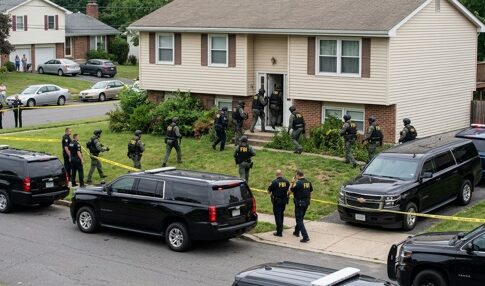
The Harding Street ruling matters because it shows how qualified immunity can turn a catastrophic police operation into a narrow legal question about what one officer could reasonably know in the moment. In practice, that means the civil case can collapse even when the underlying raid was built on falsehoods and ended in two deaths.
Key Points
- The Fifth Circuit held that Officer Felipe Gallegos was entitled to qualified immunity over the 2019 Harding Street raid.
- The court accepted the view that Gallegos acted as an objectively reasonable officer during a split-second shootout.
- The raid’s lead case agent, Gerald Goines, is already serving a 60-year sentence tied to the false warrant.
- Critics do not have public forensic evidence in the record described here that directly overturns the court’s specific reasonableness finding.
- The real fight is no longer about whether the raid was tragic; it is about whether civil liability can attach to an officer who says he did not know the warrant was built on lies.
What the Fifth Circuit Actually Decided
The core legal move is straightforward: the panel insulated Gallegos from civil suit by applying qualified immunity, a doctrine that blocks damages unless a plaintiff can show both a constitutional violation and a clearly established right that an officer would have understood he was violating. The Fifth Circuit’s reasoning, as described in the available reporting and transcript summary, was that Gallegos’s conduct was objectively reasonable in the chaos of a shootout and that courts would not second-guess his training and judgment. That is a familiar architecture in modern police-liability law; the doctrine often turns not on whether a tragedy occurred, but on whether prior precedent was close enough to make the unlawfulness “beyond debate” for every reasonable officer.
That distinction is the entire point of the case. The family’s claim may be morally compelling, and the raid was plainly rooted in official misconduct by others, but qualified immunity asks a narrower question: what did this officer know, and what was clearly established at the time? The answer the Fifth Circuit accepted was that Gallegos did not know the warrant was defective and faced a rapidly unfolding gunfight when he fired. In doctrinal terms, that is enough to end the case before a jury hears it.
Why the Warrant’s Falsehoods Did Not Control the Outcome
The strongest emotional and factual counterpoint is also the simplest: the raid itself was compromised from the start. Gerald Goines, the lead case agent who built the warrant on falsehoods, is already serving a 60-year prison sentence related to the Harding Street operation. That conviction destroys any comforting story that the raid was a routine enforcement action gone slightly wrong. It was not routine, and it was not clean. It was the product of corruption at the warrant stage, and that corruption cast a long shadow over everything that followed.
But the Fifth Circuit did not decide the case by asking whether the raid was tainted in the abstract. It focused on Gallegos’s own knowledge and conduct at the moment of the shooting. Attorney Rusty Hardin’s defense, as summarized in the transcript, was that Gallegos was unaware the no-knock warrant rested on false information supplied by Goines and was forced to make split-second decisions under fire. That framing matters because qualified immunity is often built around the officer’s perspective at the instant force is used, not the institutional rot that preceded the encounter. In other words, the doctrine is capable of compartmentalizing misconduct: the warrant can be rotten, while the firing officer is still treated as legally reasonable.
The Real Disagreement: Moral Wrongness Versus Legal Immunity
This is where the public controversy becomes much larger than the docket. Nicholas family attorney Mike Doyle publicly condemned Gallegos, saying he “deliberately killed an unarmed woman on her own couch” and later changed his story to justify the killing. That is a devastating accusation in ordinary moral language, and it resonates because the facts of the raid are already so badly compromised. Hardin, by contrast, stressed the tragedy of the deaths while arguing that if officers can be sued every time someone is unhappy with the outcome, policing becomes unworkable.
Both positions can be emotionally intelligible while only one is legally decisive. The Fifth Circuit’s task was not to measure grief or outrage; it was to decide whether existing law clearly prohibited what Gallegos did under the circumstances he faced. The current qualified-immunity framework is built to make that inquiry hard for plaintiffs, often requiring a closely analogous precedent rather than broad appeals to fairness or accountability. That is why cases like this recur: the law has a powerful instinct to separate the officer’s momentary use of force from the broader institutional failure that made the moment possible.
The result is a familiar but corrosive pattern. A court can acknowledge a death, a bad warrant, even a criminal case against the officer who lied to obtain it, and still conclude that the shooter is civilly immune because the legal test stays focused on the instantaneous use of force. Critics call that an evasion. Defenders call it discipline. In practical terms, it is both: a disciplined legal filter that often feels, to victims, like a refusal to confront the full truth.
Why the “Objectively Reasonable Officer” Standard Matters So Much
The phrase “objectively reasonable officer” is not decorative language; it is the engine of the ruling. Once a court accepts that formulation, the inquiry shifts from the messiness of the event to what a typical trained officer would have done under similar pressure. That shift is common in excessive-force litigation and is one reason qualified immunity so often ends cases before trial. The law is designed to forgive uncertainty in rapidly evolving danger, especially where officers must decide in seconds whether they are facing lethal threat.
That is also why the absence of a public forensic rebuttal in the materials provided here is important. The counter-case is forceful on morality and legitimacy, but it does not surface a named bullet-trajectory analysis, gunshot-residue report, or other primary forensic record that directly demolishes the court’s account of a shootout. Without that kind of evidence, the ruling’s specific reasonableness finding remains hard to dislodge on the record described here. The dispute becomes less about whether the raid was wrongful in a broader sense and more about whether there is proof strong enough to show that Gallegos himself could not reasonably have believed deadly force was necessary.
That gap explains why these cases are so durable. Public outrage can be substantial, even overwhelming, yet qualified immunity is not built to respond to outrage. It is built to respond to prior case law and to the officer’s claimed vantage point in the moment. If plaintiffs cannot prove that the officer knew, or should have known, that the conduct was clearly unlawful, the doctrine can absorb even a grotesque factual setting and still produce immunity.
The 5th Circuit ruled Felipe Gallegos is entitled to qualified immunity in civil claims over the 2019 Harding Street raid that killed two Houstonians. https://t.co/0lI5D5pvgA
— Houston Chronicle (@HoustonChron) June 30, 2026
What This Means for Police Accountability
The Harding Street ruling sits inside a broader federal pattern. Qualified immunity has repeatedly shielded officers from money damages, often by requiring plaintiffs to identify precedent with nearly identical facts. That framework has become one of the defining friction points in American civil-rights law because it leaves serious misconduct untethered to a remedy unless the legal system has already encountered a near-copy of the same abuse. The doctrine was meant to protect officials from hindsight litigation; in practice, it frequently protects them from accountability altogether.
That is why the case will remain important even if the appellate storyline changes. If the Nicholas family keeps pressing, the central question will not be whether the raid was awful. It was. The question will be whether discovery, deposition testimony, planning documents, or unredacted forensic material can prove that Gallegos knew enough about the defective warrant, or about the real circumstances of the encounter, to defeat the court’s immunity analysis. Until that record exists in public form, the ruling stands as a textbook example of how qualified immunity can absorb a deeply discredited police operation and still leave the shooter legally protected.
Sources:
caselaw.findlaw.com, scispace.com, law.cornell.edu, poracldf.org, eji.org, advocatemagazine.com