
An American Apache gunship just crashed in Iran’s backyard near the Strait of Hormuz—and our pilots lived to tell about it.
Story Snapshot
- Two U.S. Army Apache crew members were rescued and are in stable condition after crashing near the Strait of Hormuz.
- President Trump says “the pilots are fine” and promises a full incident report as the military investigates the cause.
- U.S. Central Command confirms the crash happened during a patrol off Oman’s coast in a tense, contested waterway.
- The incident highlights both the danger of confronting Iran’s chokehold on Hormuz and the strength of U.S. rescue capabilities.
Apache Down In One Of The World’s Most Dangerous Waters
A United States Army AH-64 Apache attack helicopter went down near the Strait of Hormuz while flying a patrol over waters off the coast of Oman, one of the most sensitive regions on earth.[1][2] The Strait of Hormuz is the narrow sea lane where a large share of the world’s oil moves and where Iran has tried for years to hold global energy supplies hostage.[5][7] The crash came as hostilities and ceasefire talks with Iran and its proxies were already under heavy strain.[3][4][5]
Reports from news outlets and military briefings agree on the most important fact for American families watching at home: both crew members survived.[1][2][3][4][5] U.S. Central Command said the two soldiers were “safely rescued within approximately two hours and are in stable condition” after their Apache went down.[1][2] The gunship crashed into the sea rather than onto land, raising the stakes for a fast rescue in dark, contested waters near Iranian-controlled shipping lanes.[1][5]
Trump: “The Pilots Are Fine” As Pentagon Probes The Cause
President Donald Trump told reporters that “the pilots are fine” and that “nobody [was] injured,” offering the first on-the-record assurance that the crew walked away without serious harm.[2][5][7] Trump spoke at John F. Kennedy International Airport after the NBA Finals, saying the administration would “issue a report tomorrow,” signaling that the White House expects a public accounting from the Pentagon once facts are confirmed.[2][3][5][7] For now, the main confirmed outcome is a successful rescue, not a loss of life.[1][2][5]
The cause of the crash remains officially unknown, and military spokesmen are clear that an investigation is underway.[1][2][3][5][7] U.S. and allied reporting say investigators are reviewing several options, including possible Iranian fire, mechanical failure, or another malfunction.[3][5] So far, there is no public proof that Iran shot down the helicopter, and both Washington and Tehran have avoided claiming it was a direct attack.[5] That uncertainty is common in early hours after any crash in a combat zone or tense region.[3][4]
First-Ever Sea Drone Rescue Shows U.S. Innovation And Resolve
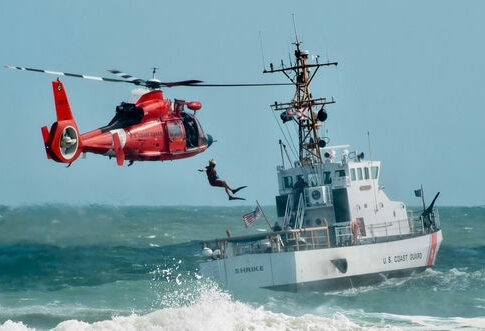
Officials familiar with the incident told reporters that the two Apache crew members were pulled from the water by an unmanned surface drone run by a Navy unit known as Task Force 59, operating with the United States Fifth Fleet in Bahrain.[1] This was reportedly the first time the U.S. military has used a sea drone to carry out a live water rescue, turning new technology into real saved lives rather than just fancy gear.[1] Central Command said they were recovered by American forces within about two hours of the crash.[1][2]
CENTCOM: Two crew members from a downed U.S. Army AH-64 Apache were pulled from waters off Oman's coast Sunday evening. Both are in stable condition after a joint rescue involving NAVCENT, the 82nd Airborne, and Task Force 59. The crash cause is under investigation.
— Imtiaz Mahmood (@ImtiazMadmood) June 9, 2026
That combination of danger and high-tech rescue fits a larger pattern in today’s Gulf standoff. American crews fly and sail every day under threat from Iranian missiles, drones, fast boats, and electronic tricks, yet they are backed by advanced systems and a commander-in-chief who openly rejects appeasing Tehran.[1][3][5][7] The United States blockade and pressure campaign has kept up even as Iran tries to keep the Strait of Hormuz under its chokehold, reminding voters what real projection of strength looks like.[4][6]
High-Risk Missions In A Region On Edge
The Apache was on a patrol mission in “regional waters” off Oman’s coast, according to U.S. Central Command.[1][2] These patrols are part of a wider effort to keep Iran from using the Strait of Hormuz to threaten shipping or sneak oil and weapons through in defiance of Western pressure.[4][6] Hours before and after the crash, media coverage focused on rising clashes tied to Iran, Israel, and proxy groups, and on how any incident could shake fragile ceasefires and energy markets.[3][4][5]
For conservative readers, this is a reminder that American service members carry the burden of defending energy security and freedom of navigation every single day, often far from home and with little fanfare.[1][2][5] The good news is that training, gear, and leadership came together here: the pilots survived, were rescued quickly, and are now in stable condition as investigators do the slow work of finding the truth.[1][2][4] Until that report comes out, any claim that the crash was simple or harmless goes beyond the proven record.[3][5]
Sources:
[1] YouTube – Two Army pilots rescued, in stable condition after Apache crash near …
[2] Web – US military helicopter crashes near Strait of Hormuz, crew rescued
[3] YouTube – US Apache helicopter crashes near the Strait of Hormuz
[4] YouTube – US helicopter crashes near Strait of Hormuz, Trump says pilots are ok
[5] Web – Accident Boeing AH-64 Apache , Tuesday 9 June 2026
[6] Web – Apache Pilots Save Comrades in Daring Rescue – DVIDS
[7] Web – Apache pilots save critically-wounded Soldier with unorthodox …