
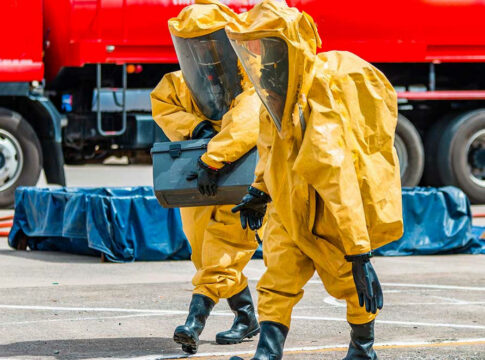
A cracked 34,000-gallon tank of explosive chemical sitting in a Southern California neighborhood forced tens of thousands from their homes — and the valve that could have fixed it didn’t work.
Story Snapshot
- A tank of methyl methacrylate at GKN Aerospace’s Garden Grove facility began leaking, overheating, and cracking, prompting a massive evacuation of 40,000 to 50,000 residents.
- A faulty, inoperable valve prevented crews from draining or neutralizing the tank, leaving officials warning it would either rupture and leak thousands of gallons or explode.
- Governor Gavin Newsom declared a state of emergency in Orange County as the crisis stretched across multiple days.
- Cooling operations eventually reduced temperatures and vapor release enough to lift evacuation orders roughly five hours after they were first issued, though the tank remained a concern.
What Was Actually Inside That Tank
Methyl methacrylate is the industrial chemical at the center of this crisis, and most people have never heard of it. It is a colorless, flammable liquid used in manufacturing acrylic plastics and aerospace components. At normal temperatures it is manageable. When it overheats, it polymerizes — meaning it undergoes a runaway chemical reaction that generates more heat, building pressure inside a sealed container until something gives. That something, in Garden Grove, was a crack discovered in the tank wall by firefighters on scene [1].
The tank held 34,000 gallons. To put that in perspective, a standard residential swimming pool holds roughly 20,000 gallons. Emergency officials were staring at nearly two swimming pools worth of a volatile, flammable, potentially explosive chemical sitting inside a populated neighborhood, with a crack in the container and a broken valve that prevented them from doing anything about it [1].
The Broken Valve Changed Everything
This is the detail that separates a serious industrial incident from a genuine catastrophe-in-waiting. Orange County fire and emergency authorities stated plainly that an inoperable valve on the tank created additional operational challenges and prevented complete mitigation [1]. In plain language: the one mechanism that could have allowed crews to drain or neutralize the chemical was not functioning. That left responders with limited options — cool the exterior of the tank with water, monitor it with drones, and hope the temperature dropped before the crack widened or the pressure spiked.
Officials told the public the tank would at some point either fail and leak thousands of gallons or explode [1]. That is not the language of bureaucratic overcaution. That is incident commanders telling residents they could not guarantee a good outcome and were operating in damage-limitation mode. When authorities speak that plainly, the evacuation zone — roughly one square mile encompassing 40,000 to 50,000 people — is not an overreaction. It is the textbook response to a low-probability, catastrophic-consequence scenario.
Newsom’s Emergency Declaration and What It Actually Does
Governor Gavin Newsom’s declaration of a state of emergency in Orange County unlocked state resources, streamlined agency coordination, and removed bureaucratic friction from the response. Emergency declarations of this kind are standard tools in California’s crisis management playbook, and in this case the scale of the evacuation and the nature of the threat — a cracking industrial tank with a broken safety valve in a dense residential area — clearly met the threshold. The declaration also creates a paper trail that matters later when residents, businesses, and local governments seek reimbursement for losses and response costs.
California authorities are racing to prevent a damaged chemical tank at the GKN Aerospace plant in Garden Grove from exploding after discovering a crack that may be releasing pressure, while over 50,000 residents remain under evacuation orders. https://t.co/9T6aiodekG pic.twitter.com/2bFW7Aslk9
— China Xinhua News (@XHNews) May 25, 2026
The Orange County District Attorney’s office set up a tip hotline to gather information about the hazardous materials incident at GKN Aerospace, a signal that investigators are already looking at whether negligence, deferred maintenance, or regulatory failures contributed to the crisis. That is the right instinct. A 34,000-gallon tank of volatile chemical does not develop a crack and a broken valve overnight. Industrial facilities have inspection schedules, maintenance logs, and regulatory oversight for exactly this reason. Those records will tell a story.
When the All-Clear Comes, the Questions Begin
Cooling operations did reduce the chemical’s temperature and slow the vapor release, and evacuation orders were lifted approximately five hours after they were issued [1]. That outcome is genuinely good news. But a successful de-escalation does not mean the system worked — it may mean the system got lucky. Tens of thousands of people were displaced from their homes, shelters filled up across the region, and a major aerospace facility sat at the center of a potential mass-casualty event because a valve failed and a tank cracked. The chemical didn’t explode this time. The harder question is what maintenance and inspection failures put 50,000 people in that position to begin with, and whether anyone in a position of responsibility at GKN Aerospace will be held accountable for the answer.
Sources:
[1] Web – Thousands evacuated around leaking Orange County chemical tank