
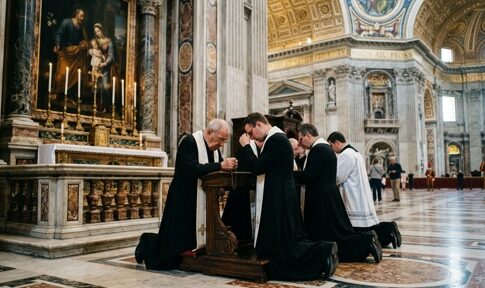
Cardinal Robert Sarah charges that modern liturgy has devolved into mere entertainment, echoing pagan self-worship and eroding the Catholic Church’s sacred core.
Cardinal Sarah’s Liturgical Critique Emerges
Cardinal Robert Sarah released The Song of the Lamb: Sacred Music and the Heavenly Liturgy in November 2025. Co-discussed with Peter Carter of Princeton’s Aquinas Institute, the book targets post-Vatican II changes. Sarah declares liturgy instrumentalized into entertainment, a battlefield, or self-focused rite. This shifts emphasis from God’s glory to human expression, resembling pagan “work of the people” rather than Christ’s sacrifice. His words demand urgent restoration.
Princeton Speeches Ignite Debate
On November 21-22, 2025, Sarah spoke at Princeton University. He questioned why liturgy became a divisive arena. Traditional Latin Mass attendees, he noted, prove vibrant practicing Catholics. Sarah urges bishops to foster coexistence of liturgical forms without coercion. His tenure as Prefect of the Congregation for Divine Worship from 2014 to 2021 lends unmatched authority. Facts support his view: reverence draws the faithful, while novelty risks emptiness.
Peter Carter reinforced Sarah’s message. Gregorian chant forms liturgy’s heartbeat, linking earth to heaven. Post-council experiments with guitars and folk tunes dilute this sacred pulse. Sarah contrasts Vatican II’s Sacrosanctum Concilium, which sought noble simplicity, with actual “bad creativity” and convivial shows. Common sense affirms: timeless rites endure because they transcend trends.
Historical Roots of the Crisis
Vatican II’s 1962-1965 councils sparked reforms via the 1969 Novus Ordo Missae. Vernacular languages and active participation aimed to engage laity. Yet Benedict XVI’s 2007 Summorum Pontificum freed the Traditional Latin Mass. Francis’ 2021 Traditionis Custodes curtailed it, fueling wars. Sarah, from Guinea, highlights African orthodoxy against Western syncretism. His 2016 book God or Nothing and 2019 calls for ad orientem worship build this case.
Sarah laments loss of the “gaze toward the cross.” Parishes feature contemporary music, turning Mass into performance. Traditional pockets grow, as Sarah observes TLM vitality. This divide polarizes: progressives push inculturation, traditionalists defend heritage. Sarah critiques bullying on both sides, seeking peace. Conservative principles favor proven sanctity over risky reinvention.
Implications for Church Unity
Short-term, Sarah’s voice heightens tensions but boosts traditionalist morale. Long-term, it risks schism without Vatican clarity on music and Mass forms. Global Catholics, especially in Africa and Latin America, weigh sacrality against local adaptation. Publishing and sacred music sectors thrive from his influence. Seminaries may shift to chant hymnals. Facts align with his authority: CDW experience proves his diagnosis sound.
Sarah positions liturgy as the Church’s source and summit. Restoring it prevents self-demolition. His prophetic stance, rooted in two millennia of guardianship, calls believers to heavenly worship. Amid 2025 debates under evolving papacies, his message endures as a beacon for fidelity.
Sources:
In New Book, Cardinal Sarah Delves Deeply into Worship, Liturgy, and Sacred Music
Cardinal Sarah on Sacred Music
Cardinal Sarah: Why Have We Turned
Cardinal Sarah’s The Song of the Lamb Explores the Beauty of Catholic Sacred Music
Cardinal Sarah’s Cri de Coeur: The Catholic Church Has Lost Its Sense of the Sacred
Cardinal Sarah Says Liturgy Has Been Reduced to Mere Entertainment